
Editorial
Making Local Government Work for the People
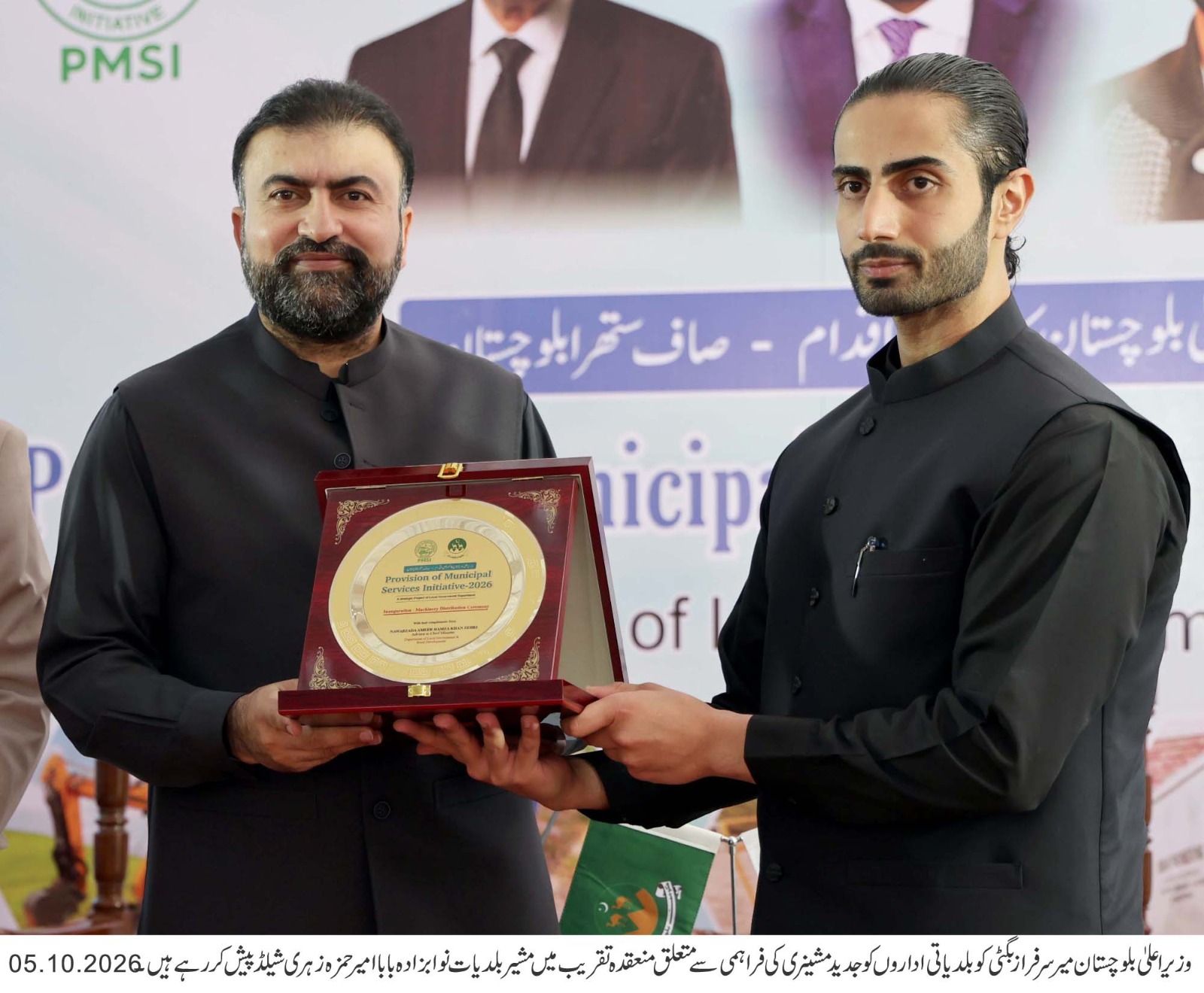
Good governance is ultimately measured not only by major development projects or policy announcements, but by the quality of services that citizens experience in their everyday lives. Clean streets, efficient waste disposal, functioning drainage systems and responsive municipal institutions are among the most basic indicators of an effective government. In this context, the Balochistan government’s Municipal Services Initiative 2026 represents an important step towards strengthening local governance and bringing municipal services closer to the people.
Chief Minister Mir Sarfaraz Bugti’s assurance that the provincial government is fully prepared to hold the next local government elections, with no excuse for delay, is equally significant. The current term of local governments is scheduled to end in February 2027. Ensuring that the electoral process proceeds on time would reinforce the principle that local institutions are an essential component of democratic governance rather than an administrative formality.
The decision to equip municipal committees with modern machinery addresses one of the longstanding weaknesses of municipal administration in Balochistan. Limited resources, inadequate equipment and insufficient capacity have often made it difficult for local institutions to respond effectively to growing urban needs. Providing sewerage suction trucks, sanitation rickshaws, garbage containers, hand carts and dustbins can substantially improve the capacity of municipal bodies, particularly in densely populated and narrow urban areas.
The importance of this initiative goes beyond the machinery itself. The real test will be whether these resources are properly managed, maintained and deployed where they are most needed. Every public investment must translate into a measurable improvement in service delivery. For this reason, monitoring, transparency and accountability should remain central to the implementation of the programme.
The experience of Chaman offers an instructive example. The accumulation of large quantities of garbage had become a visible manifestation of an institutional problem. Once the matter received administrative attention, a determined cleanliness campaign demonstrated that improvements are possible when officials treat public service delivery as a responsibility rather than merely a routine assignment.
Yet government machinery alone cannot keep cities clean. Municipal services require an active partnership between institutions and citizens. Public authorities can provide equipment, establish systems and enforce regulations, but residents must also assume responsibility for disposing of waste properly and protecting their neighbourhoods. The proposed campaign against polythene bags is therefore relevant not only as an environmental measure but also as part of a broader effort to change public behaviour.
Technology can further strengthen this process. Complaint-reporting applications that provide citizens with direct access to the Chief Minister’s Secretariat can help create a more responsive system. Such mechanisms should be supported by timely action, transparent tracking and clear responsibility at the administrative level. A complaint mechanism is meaningful only when citizens can see that their complaints lead to results.
The upcoming local government elections provide another opportunity to strengthen this framework. Elected local representatives, empowered municipal institutions and adequately resourced administrations can create a more direct link between citizens and government. Provincial oversight should support these institutions without weakening their capacity for local decision-making.
Balochistan faces unique geographical, financial and human-resource challenges. These realities make efficient local governance even more important. The objective should not simply be to introduce new machinery, but to build municipal institutions capable of planning, responding and delivering consistently.
The success of the Municipal Services Initiative 2026 will therefore be judged on the streets of Balochistan’s towns and cities. If cleaner neighbourhoods, better waste management and more responsive municipal services become visible in people’s daily lives, the initiative will have achieved its purpose. For ordinary citizens, meaningful reform is not an abstract concept; it is the difference between a neglected street and a clean one, between an unanswered complaint and an effective response, and between a government that promises change and one that delivers it.