
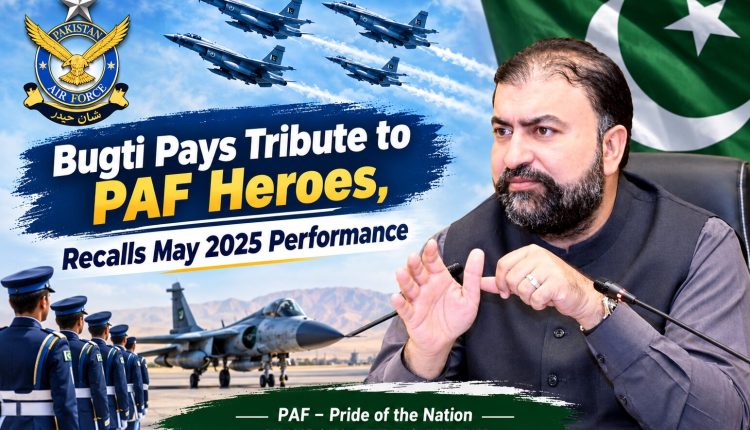
CM Sarfraz Bugti salutes PAF heroes on Air Force Day, recalls Rashid Minhas Shaheed’s legacy
Quetta, Chief Minister Balochistan, Mir Sarfraz Bugti, has paid glowing tributes to the Pakistan Air Force (PAF) on the occasion of Air Force Day, saluting the courage, sacrifices, and professional excellence of its officers, martyrs, and veterans.
In his special message, Bugti said the PAF’s role in defending the nation’s airspace is an unforgettable chapter of national history. He recalled the legendary sacrifice of Rashid Minhas Shaheed and other valiant airmen who wrote timeless stories of bravery and devotion to the motherland. “Their sacrifices remain a shining symbol of determination, courage, and patriotism for future generations,” he noted.
Sarfraz Bugti highlighted that during the Marka-e-Haq in May last year, the PAF demonstrated extraordinary skill, modern combat capability, and unmatched bravery, further strengthening the tradition of defending Pakistan’s skies. “The effective and commendable performance of our air warriors made the entire nation proud and reaffirmed that the defense of Pakistan’s airspace rests in strong and capable hands,” he said.
He emphasized that Air Force Day is not merely a national commemoration but also an opportunity to renew the pledge of national unity, unwavering resolve, and loyalty to the homeland. Bugti said the nation holds its airmen in the highest esteem and takes pride in their professionalism, courage, and sense of duty.
The Chief Minister stressed that martyrs who laid down their lives for the country’s defense are the true heroes of the nation, whose sacrifices will never be forgotten. He assured that the entire nation stands firmly with the families of martyrs.
Sarfraz Bugti prayed for the elevation of ranks of all PAF martyrs, their eternal place in Jannat-ul-Firdous, and patience for their families. He also extended best wishes for the safety, success, and continued excellence of the PAF’s veterans and serving officers.
[9/7, 5:44 PM] CM Balochistan Press Secy. Shiekh Razaq Sab. Cliping Section.: Reclaiming Quetta: The City’s Battle Against Encroachments
By Rakhshanda Saba
A city is not defined merely by its buildings, roads and markets; its true character is reflected in how comfortably and safely its people can move through it. For Quetta, a city already facing the pressures of rapid urbanisation, increasing traffic and limited public spaces, the issue of encroachments has become one of the most visible challenges to orderly urban life.
In this context, the ongoing campaign against encroachments across Quetta represents more than a routine administrative exercise. It is part of a broader effort to restore public spaces and bring greater discipline to the provincial capital. Under the vision of Chief Minister Balochistan Mir Sarfraz Ahmed Bugti, the authorities are seeking to make Quetta cleaner, more organised and more accessible for its residents.
One of the most common forms of encroachment can be seen outside commercial establishments, where tables, chairs, displays and other items frequently spill onto footpaths and roads. What may appear to be a small extension of a business premises can, collectively, create serious difficulties for thousands of citizens.
Fatima Jinnah Road is a case in point. During a recent inspection carried out by Municipal Magistrate Imran Zaib Kasi on the directions of Quetta Metropolitan Corporation Administrator Bashir Ahmed Barich, several hotels were found occupying public space by placing tables and chairs on roads and footpaths.
The consequences of such practices extend beyond inconvenience. When footpaths are blocked, pedestrians are compelled to walk alongside moving traffic. When roads are narrowed by private use, congestion increases and the smooth movement of vehicles is affected. The problem becomes even more serious in busy commercial areas where every additional obstruction adds to the pressure on already congested streets.
The authorities had reportedly warned the concerned hotel owners repeatedly against occupying public spaces. They were instructed not to place tables, chairs or other equipment on roads and footpaths and not to interfere with traffic movement. Continued violations eventually resulted in the arrest of four hotel owners, who were sent to jail.
The action sends a clear message: commercial activity is welcome, but it cannot come at the expense of public rights.
At the same time, an effective anti-encroachment campaign must maintain a careful balance between enforcement and the legitimate interests of the business community. The purpose should not be to discourage trade or undermine livelihoods. Rather, businesses need to operate within clearly defined boundaries so that commercial activity and public convenience can coexist.
The challenge, therefore, is not simply removing encroachments once. The real test lies in ensuring that public spaces remain free after they have been cleared. This requires consistent enforcement, effective municipal management and, most importantly, cooperation from citizens and traders.
Urban cleanliness and civic discipline cannot be achieved by government institutions alone. Citizens also have a responsibility to respect public spaces and understand that roads and footpaths belong to the community as a whole. A restaurant or shop may benefit from additional space, but thousands of pedestrians should not be deprived of their right of passage for that private benefit.
Quetta has immense potential to become a more attractive, accessible and liveable city. Reclaiming its roads and footpaths is an important part of that transformation. The ongoing campaign, if sustained with fairness and consistency, can help establish a stronger culture of civic responsibility.
Ultimately, a cleaner and more organised Quetta will not be created merely through official orders or enforcement operations. It will emerge when government, traders and citizens collectively recognise that public space is a shared asset.
The battle against encroachments is, therefore, not simply a battle against tables, chairs or illegal extensions. It is a larger effort to reclaim the city for the people who live in it—and to ensure that Quetta’s roads, footpaths and public spaces remain accessible, safe and dignified for everyone.