
CM Sarfraz Bugti launches Police digital initiatives, warns property owners sgainst facilitating terrorism
Announces formation of a committee to probe complaints regarding Tehsildar recruitment in the Balochistan Public Service Commission, with its report to be made public
Chief Minister Balochistan Mir Sarfraz Bugti has warned that if attacks on the provincial interior minister or security forces are carried out from vineyards in Mastung, the property owners will not be absolved of responsibility but treated as facilitators of terrorism.
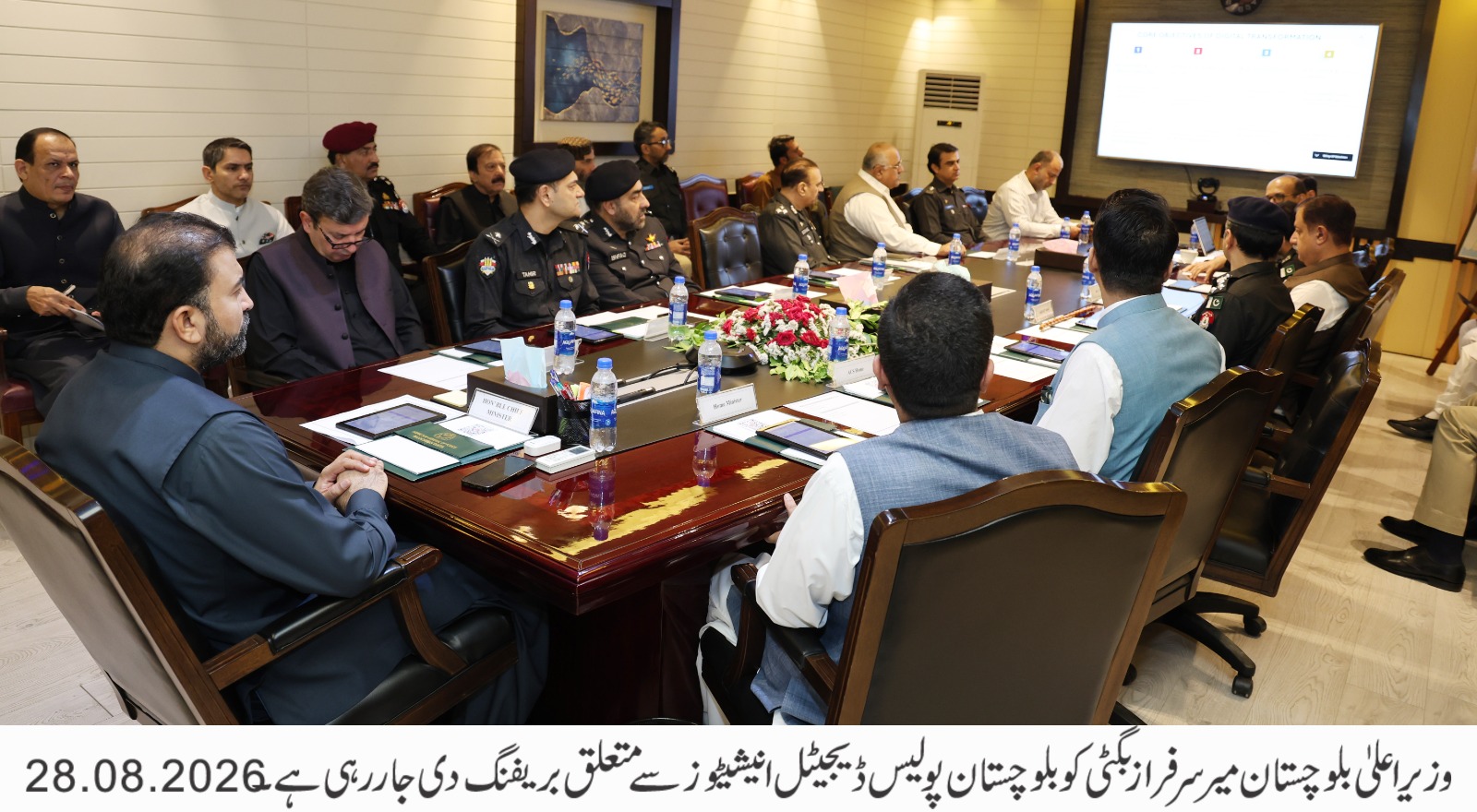
Speaking at the launch ceremony of Balochistan Police’s digital initiatives at the Central Police Office Quetta, Sarfraz Bugti also announced the formation of a committee to probe complaints regarding Tehsildar recruitment in the Balochistan Public Service Commission, with its report to be made public.
Sarfraz Bugti emphasized that the provincial government is committed to taking governance toward maximum digitalization, as it enhances public service, transparency, and efficiency. He praised the police for introducing 16 upgraded and new applications, noting that these will assist citizens not only in the criminal justice system but also in resolving day-to-day grievances.
He highlighted that special digital facilities for women and families of martyrs will strengthen public trust. The women’s protection app, he said, is of particular importance, enabling female students and professionals to declare emergencies and notify parents and police instantly. The Chief Minister announced a public awareness campaign to ensure women feel safe at workplaces, on roads, and during travel.
Sarfraz Bugti stressed that the government’s response to extremist elements misusing youth and women is to empower them through scholarships, international education opportunities, Pink Scooties, Pink Buses, stronger workplace harassment laws, and modern digital facilities.
He announced a cash reward of Rs. 5 million for the police IT team and pledged Rs. 50 million for further digitalization this year. Bugti thanked the Punjab Government and Punjab Police for their cooperation, noting that Sindh and Gilgit-Baltistan have also sought to adopt Balochistan’s AI-based merit testing system.
Sarfraz Bugti assured the families of martyrs that the government stands firmly with them, while also promising salary adjustments for police personnel in line with inflation, especially for frontline units such as ATF, CTD, and SOW. He acknowledged that reforms may initially cause discomfort but insisted that true leadership makes correct decisions, not just popular ones.
He expressed confidence that within three to four years, Balochistan Police will emerge as one of Pakistan’s strongest and most empowered forces, equipped to counter terrorism and crime effectively. Sarfraz Bugti stressed that Safe City projects and CCTV systems have already proven vital in solving major cases, and with continued reforms, Balochistan’s policing system will be transformed into a modern, transparent, and citizen-focused service.
Chief Minister Balochistan Mir Sarfraz Bugti has declared that establishing the state’s writ is the government’s foremost responsibility, stressing that the province is facing an intelligence-based war against Pakistan, with clear evidence of foreign involvement, including links to India’s RAW and the case of Kulbhushan Yadav.
Sarfraz Bugti explained that Balochistan’s geostrategic position and vulnerabilities have made it a buffer zone, exposing it to terrorist attacks. He cited two major reasons for the recent surge in terrorism: the availability of modern weapons left behind by NATO forces in Afghanistan, now circulating in the black market, and the exploitation of Baloch youth by extremist elements pushing them into a futile conflict.
He emphasized that while terrorists attempt to portray control by attacking isolated points, the reality is that the state protects over 4,000 kilometers of highways, and more than 1,000 hardcore terrorists have been neutralized in the past year. Bugti asserted: “This is guerrilla warfare, but it is not a thousand-year war. It will end in one to two years, and it is the terrorists who will tire, not the state.”
On the issue of Mastung vineyards being used for attacks, Bugti warned that property owners cannot claim ignorance if their land is exploited for terrorism. He made it clear that such owners will be treated as facilitators, adding that the government may be compelled to either relocate populations or eliminate orchards used for attacks if warnings are ignored. “The blood of our soldiers is sacred. It cannot be cheapened by allowing private properties to become terrorist sanctuaries,” he said.
Sarfraz Bugti also addressed concerns about Tehsildar recruitment in the Balochistan Public Service Commission, revealing that an internal error had been identified. A committee has been formed to investigate, with its report to be presented to the media within 7–10 days. He reaffirmed that the government’s policy is “Meritocracy, Meritocracy, and Meritocracy”, insisting that only merit can reconnect the youth with the state.
Citing the recent Balochistan Revenue Authority recruitments, Bugti noted that despite political expectations, no candidate from his own constituency of Dera Bugti was selected, proving that the process was strictly merit-based. He stressed that he would rather lose elections than compromise on merit, declaring: “The state is more important to me than any political interest, even more important than my 70-year-old mother.”
Sarfraz Bugti concluded that merit is the key to good governance, and the government will not compromise on it under any circumstances. He assured that Balochistan has a clear plan to counter terrorism and strengthen governance, and that the sacrifices of security forces will not go in vain.