
Editorial
Balochistan’s Path to Peace and Development Requires a Strong Federal-Provincial Partnership
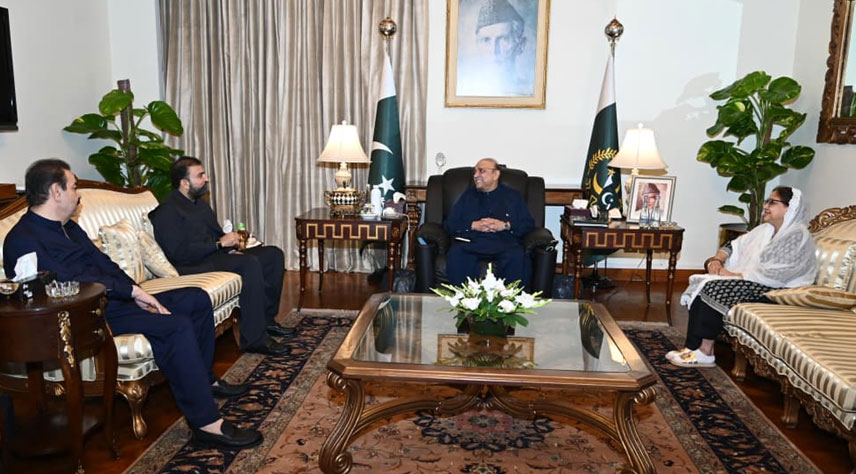
The meeting between President Asif Ali Zardari and Balochistan Chief Minister Mir Sarfraz Bugti in Islamabad carries significance beyond the routine exchange of briefings between federal and provincial leadership. At a time when Balochistan faces intertwined challenges of security, development and public welfare, the message emerging from the meeting is clear: lasting peace and sustainable development require a strong partnership between the federal and provincial governments.
Balochistan is Pakistan’s largest province by area, yet its vast geography, scattered population and difficult terrain have historically made the delivery of public services and development infrastructure a formidable challenge. The province also possesses enormous economic potential, particularly in minerals, agriculture, fisheries, energy and its strategic coastline. Unlocking this potential requires political stability, effective governance and sustained investment.
President Zardari’s emphasis on providing Balochistan with special attention and resources is therefore both timely and necessary. Treating the province merely as a security challenge would be a serious policy mistake. Balochistan must increasingly be viewed through the broader lens of development, human capital, economic opportunity and social inclusion.
Security, however, remains an indispensable foundation. Development cannot flourish where citizens, investors and institutions remain vulnerable to violence. The President’s assertion that externally supported terrorist elements seeking to obstruct Balochistan’s development will be defeated reflects the state’s determination to protect the province’s progress from forces that seek to exploit insecurity.
But the fight against terrorism must be accompanied by a parallel struggle against poverty, unemployment, illiteracy and exclusion. Security operations can address immediate threats, but sustainable peace depends upon creating conditions in which young people have reasons to believe in their future.
This is where the approach of Chief Minister Mir Sarfraz Bugti deserves attention. His administration has increasingly sought to link security with development and public welfare. The central idea is simple but important: the state must not only protect citizens from violence; it must also provide them with education, healthcare, employment opportunities and effective public services.
For Balochistan, youth development should be at the heart of this strategy. A large proportion of the province’s population is young. This demographic reality can become either a tremendous asset or a serious challenge. If young people receive quality education, technical skills, employment opportunities and platforms for constructive participation, they can become the strongest force for peace and economic transformation.
The same principle applies to women. Greater investment in women’s education, skills, entrepreneurship and economic participation can strengthen families and expand the province’s productive capacity. A development strategy that excludes women cannot produce inclusive prosperity.
Another essential component is institutional trust. Citizens are more likely to reject violence and extremism when they believe that legitimate grievances can be addressed through constitutional and democratic institutions. Merit-based recruitment, transparent governance, efficient administration and accessible justice can therefore serve as important instruments of peace.
The federal government has a critical role in this process. Balochistan’s geographical scale and developmental needs require resources beyond the province’s own fiscal capacity. Federal support for infrastructure, education, healthcare, connectivity, water management and economic projects must therefore be sustained and predictable rather than episodic.
At the same time, provincial leadership must ensure that available resources are utilized efficiently and transparently. Development funds should translate into visible improvements in the lives of ordinary citizens. Roads, schools, hospitals, water supply schemes and employment programmes matter because they create a tangible relationship between the citizen and the state.
The federal-provincial relationship should consequently move beyond political rhetoric. Regular coordination, joint planning and institutional mechanisms for resolving bottlenecks can substantially improve implementation. President Zardari’s call for effective federal-provincial coordination is particularly relevant in this context.
There is also a need to strengthen the political and social dimensions of peace. Tribal elders, political parties, religious scholars, civil society, journalists, academics and young people all have roles to play in building a culture of dialogue. No government can establish lasting peace through administrative measures alone. Peace ultimately becomes sustainable when society itself begins to see stability as a shared interest.
Chief Minister Mir Sarfraz Bugti’s emphasis on peace, development and public welfare provides an important direction for provincial policy. His challenge, however, is equally significant: expectations are high, and the people of Balochistan will ultimately judge policies by results rather than announcements.
The road ahead will not be easy. Terrorism, underdevelopment and historical grievances are complex problems that cannot be resolved overnight. Yet the combination of effective security, political engagement, economic development and social investment offers a realistic pathway forward.
The President’s assurance that the day is not far when terrorism will be eliminated from Balochistan should be viewed not simply as a statement of optimism, but as a national objective requiring sustained commitment.
Balochistan does not need to be defined by its problems. It can increasingly be defined by its potential. With federal support, capable provincial leadership and meaningful participation of its people, the province can emerge as a centre of peace, investment and prosperity.
The real measure of success will be when a child in Balochistan can attend school without fear, a young person can find meaningful employment at home, a farmer can prosper, a woman can pursue her ambitions, and an investor can see the province not as a risk but as an opportunity.
That is the Balochistan that both peace and development should ultimately seek to build.