
Balochistan Needs Facts, Not Misleading Narratives
By Rakhshanda Saba
Balochistan is often discussed through the lens of deprivation, conflict and political grievances. However, the province’s challenges cannot be understood through a single narrative. Chief Minister Balochistan Mir Sarfraz Bugti has argued that the fundamental challenge is not merely backwardness but a misleading narrative that creates a gap between perception and reality. His remarks underline the need to examine Balochistan through facts, historical context and the experiences of its people.
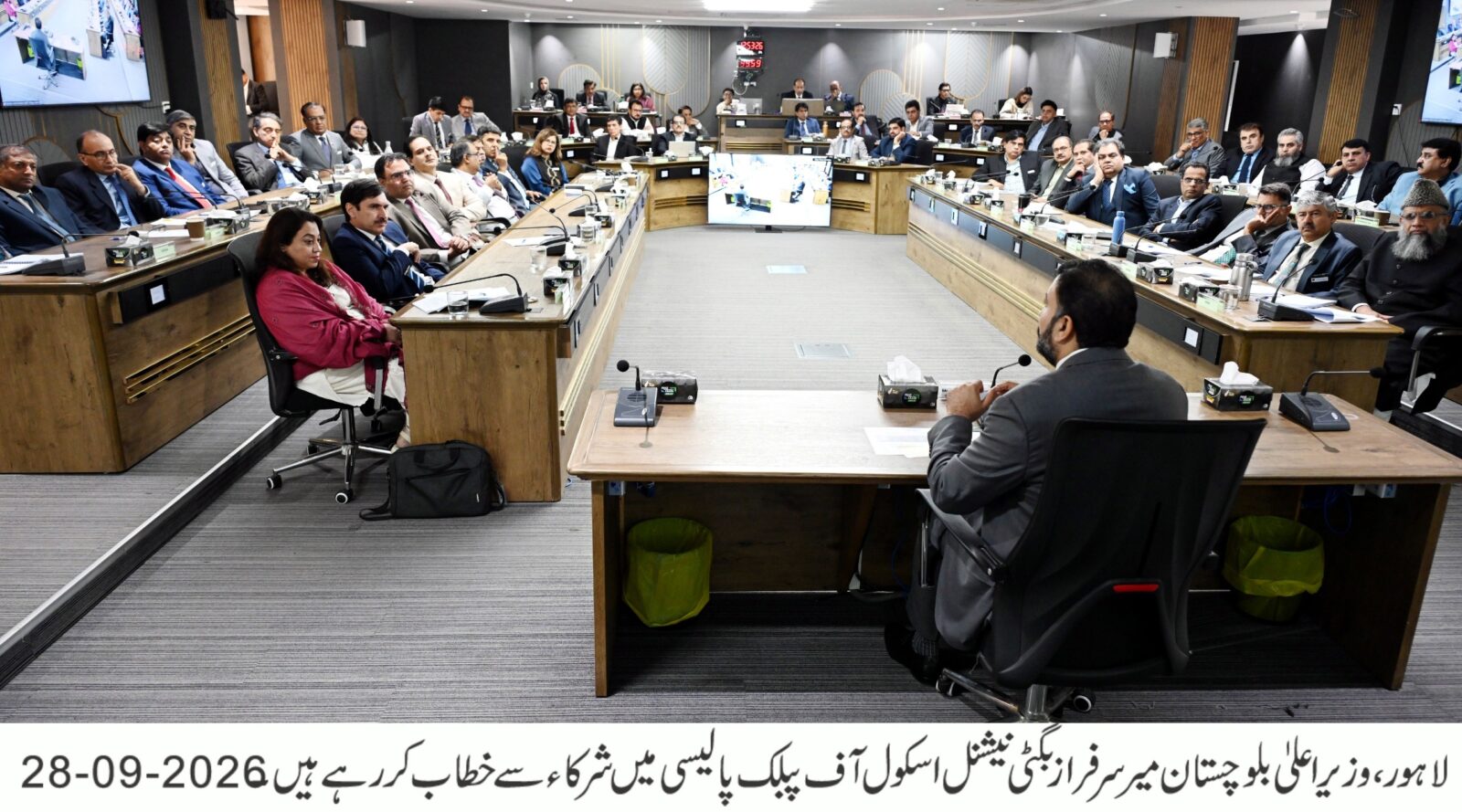
Addressing participants at the National School of Public Policy in Lahore on Monday, September 28, 2026, the Chief Minister said there was a need to distinguish between facts and perceptions. He observed that the accurate history of Balochistan was unfortunately not always presented in contemporary discourse, resulting in a distorted understanding of the province’s political and social realities.
Balochistan undoubtedly faces serious development challenges. Yet, as Bugti pointed out, deprivation is not unique to the province and exists in varying forms across Pakistan. Developmental challenges, however, cannot by themselves justify taking up arms against the state or advocating the disintegration of the country. He maintained that the dream of breaking up Balochistan could never be fulfilled and referred to Article 5 of the Constitution, which emphasizes loyalty to the state.
At the same time, the Chief Minister highlighted the importance of addressing the distance between young people and the state through dialogue and engagement. He said that the government was listening to the youth at every level in an effort to reduce this gap. This approach recognizes that young people must have space to express their concerns, aspirations and expectations within constitutional and democratic frameworks.
Bugti also drew a distinction between political engagement and armed violence. He said the government remained ready to engage in dialogue with political actors at all times, but negotiations could not be held with those who had taken up arms. The distinction, he suggested, was important for maintaining political space while upholding the authority of the state.
Historical understanding was another important aspect of his address. Referring to the accession of Balochistan to Pakistan, Bugti argued that the subject should be examined through historical sources and original records. He referred to the Khan of Kalat’s own account, saying that it recorded the accession as having taken place with his consent. Regardless of differing interpretations surrounding historical events, the broader point is that public understanding should be based on primary sources, documented evidence and serious historical scholarship.
The Chief Minister also raised concerns about the reluctance of some federal bureaucrats from Punjab to serve in Balochistan. He questioned how officials could fully understand the province’s realities without experiencing conditions on the ground. Effective governance, he emphasized, requires direct engagement with communities and an understanding of local circumstances.
For Balochistan, therefore, the way forward requires more than development figures and administrative plans. It requires informed policymaking rooted in facts, historical understanding and direct engagement with citizens. Bridging the gap between perception and reality can help create a more nuanced understanding of the province and enable institutions to respond more effectively to the needs and aspirations of its people.