
Provincial consultation on human rights treaty held in Quetta
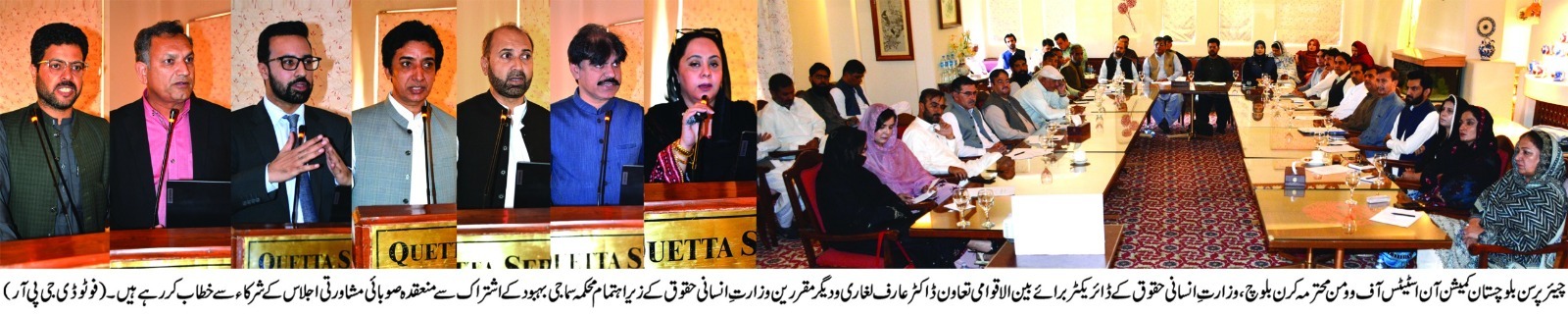
Quetta, The Ministry of Human Rights, in collaboration with the Provincial Department of Social Welfare and Human Rights, organized a provincial consultative session in Quetta on the International Covenant on Economic, Social and Cultural Rights. The meeting aimed to review legal, administrative, and policy measures taken at the provincial level and gather inputs for Pakistan’s second periodic national report to be submitted to the relevant United Nations committee.
The session was attended by Chairperson Balochistan Commission on Status of Women Kiran Baloch, Director International Cooperation at the Ministry of Human Rights Dr. Arif Laghari, Additional Secretary Social Welfare Inayatullah Khan, Director Abduhu, Additional Secretary Law Shaukat Ali, Commandant Balochistan Constabulary Ms. Shaheela, former Vice Chancellor University of Makran Dr. Mumtaz Baloch, Regional Director Ministry of Human Rights Asfandyar Badini, representatives Zulfiqar Ali and Ahsan Shamim, Assistant Director Public Relations Manzoor Ahmed Magsi, as well as officials from the Home Department, Benazir Income Support Programme, Labour Department, Inter‑Provincial Coordination, Mines and Minerals Department, civil society, and academia.
Dr. Arif Laghari highlighted that Pakistan ratified the covenant in 2008, which obliges the country to periodically update the UN committee on measures taken to implement recognized rights including employment, education, health, social protection, and adequate living standards. He noted that following the 18th Constitutional Amendment, many of these sectors fall under provincial jurisdiction, making provincial consultations essential for compiling a comprehensive national report.
The Quetta session discussed issues specific to Balochistan such as workers’ rights, social protection, women’s empowerment, education, healthcare facilities, ownership and management of natural resources, and matters related to mining. Chairperson Kiran Baloch underscored the importance of safeguarding women’s rights and ensuring equal opportunities in education, health, employment, and decision‑making processes for sustainable development.
At the conclusion, departments were requested to provide updated data and information for inclusion in the national report. Participants’ active involvement was termed a success for the consultative process. The Ministry of Human Rights has already held similar sessions in Lahore and Peshawar, with upcoming consultations planned in Sindh and Islamabad before finalizing Pakistan’s second periodic report for submission to the UN committee.
Participants emphasized that this collaborative process between federal and provincial stakeholders is vital for fulfilling Pakistan’s international human rights commitments and ensuring evidence‑based reporting from across the country. The Ministry of Human Rights expressed gratitude to the Government of Balochistan, relevant departments, and all institutions for their cooperation, pledging to continue such efforts in the future.