
Editorial
When Every Minute Matters: Transforming Emergency Healthcare in Balochistan
In emergency healthcare, time is often the most valuable resource. A few minutes can determine whether an injured person receives timely treatment or suffers complications that could have been prevented. In a province as vast and geographically challenging as Balochistan, ensuring rapid access to emergency medical care is therefore not merely a healthcare objective; it is a critical public service.
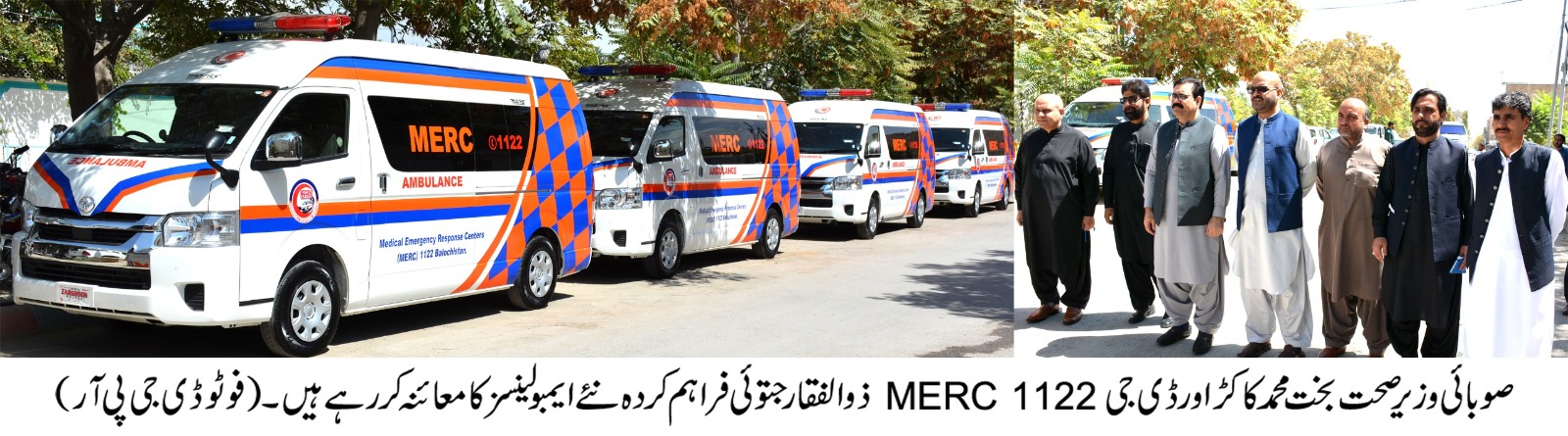
The ongoing strengthening of MERC 1122 reflects an important shift towards a more organised, responsive and technology-enabled emergency healthcare system. The introduction of nine new ambulances equipped with advanced life-support facilities, along with the launch of an emergency response software system, represents a significant step towards improving the way emergencies are managed across the province.
Provincial Health Minister Bakht Muhammad Kakar has rightly emphasised the need to modernise ambulance services so that victims of road accidents and other emergencies can receive immediate assistance. Under the MERC 1122 system, patients are provided initial medical care and, where necessary, transported to trauma centres or other appropriate healthcare facilities.
This model is particularly relevant to Balochistan, where long distances between population centres and specialised healthcare facilities can turn an emergency into a race against time. For people living in remote districts and communities along major highways, the availability of a professionally equipped ambulance can mean the difference between reaching a hospital in time and losing a precious opportunity for treatment.
The addition of nine advanced life-support ambulances can strengthen the capacity of emergency responders to provide care before a patient reaches hospital. However, the significance of the initiative goes beyond the number of vehicles added to the fleet. What matters equally is how efficiently those resources are deployed.
This is where the newly introduced digital emergency response software can make a practical difference. The ability to monitor the location, availability and movement of ambulances across Balochistan can help authorities identify the nearest available vehicle and dispatch it to an emergency without unnecessary delay. Better information can lead to better decisions, while real-time monitoring can improve accountability and the overall use of available resources.
Director General MERC 1122 Zulfiqar Jatoi has highlighted the potential of the new system to improve response times, while Director General Health Services Balochistan Dr Muhammad Amin Mandokhail has emphasised the department’s efforts to extend timely healthcare to remote areas. These objectives are particularly important in a province where geography remains one of the major barriers to access.
Another significant proposal is to bring all ambulances in Balochistan under the 1122 command and control system. An integrated network could reduce fragmentation and create a more coordinated emergency response mechanism, allowing citizens to access ambulance services through a unified system.
Yet technology and equipment alone cannot create an effective emergency healthcare network. Its success depends on trained rescuers, functional communication systems, capable hospitals, trauma facilities and strong coordination among health authorities. The chain of emergency care must remain connected from the site of an incident to the patient’s arrival at a suitable medical facility.
MERC 1122 personnel working around the clock deserve recognition for operating on the frontline of this system. Their work demonstrates that emergency healthcare is ultimately about people as much as infrastructure. Ambulances, software and control rooms can support the process, but trained and committed responders remain its most important component.
The broader health reforms being pursued under the vision of Chief Minister Mir Sarfraz Bugti should therefore continue to focus on accessibility, efficiency and measurable public benefit. In a province where distance can itself become a healthcare challenge, digitalisation and integrated emergency services can help narrow the gap between citizens and timely medical care.
The real test of an emergency healthcare system is not how impressive its infrastructure appears, but how quickly it reaches someone when help is urgently needed. If the expansion of MERC 1122 is matched by effective coordination, trained personnel, reliable technology and wider coverage, Balochistan can establish a stronger emergency response model.
For an injured citizen lying on a roadside, there is no statistic more important than the arrival of help. Every minute matters, and strengthening emergency healthcare means giving those minutes back to the people who need them most.