
Editorial
Pakistan-Saudi Defence Partnership: A Commitment to Peace Through Strength
The signing of the Makkah Joint Defence Agreement by Pakistan, Saudi Arabia and Türkiye marks an important development in the evolving security landscape of the Muslim world. More than a conventional defence arrangement, the agreement reflects a shared understanding that peace and stability require collective responsibility, strategic coordination and credible deterrence.
Pakistan and Saudi Arabia have enjoyed decades of close and brotherly relations, extending from political and economic cooperation to defence and security. The new agreement gives an institutional framework to a relationship that has already developed considerable depth over the years. Türkiye’s inclusion further broadens the strategic significance of the arrangement and creates an opportunity for greater coordination among three important regional powers.
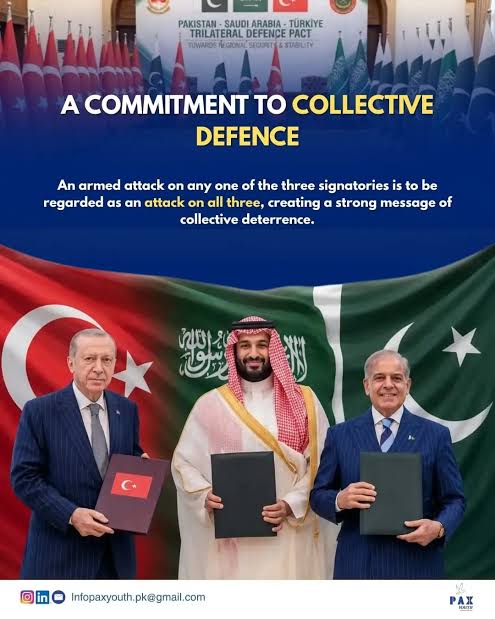
The agreement is explicitly defensive in character. Pakistan’s Foreign Ministry has stated that it is not directed against any country and is intended to strengthen collective deterrence against external aggression while protecting sovereignty and territorial integrity. Under the agreement, an armed attack against any one of the three countries is to be regarded as an attack against all, in accordance with the principles of individual and collective self-defence under international law.
The importance of such an arrangement becomes clearer against the backdrop of growing instability in the wider region. Conflicts and rivalries across the Middle East have repeatedly demonstrated how quickly local tensions can affect energy supplies, international trade and regional security. Recent attacks against Saudi Arabia have further underscored the importance of collective security arrangements, while Pakistan has simultaneously continued to emphasise dialogue, restraint and peaceful resolution of disputes.
This is where the real strength of the Makkah Agreement lies. A credible defence partnership should not be viewed simply as preparation for conflict. Its greater purpose should be to make conflict less likely. Effective deterrence, regular military coordination, joint training, defence technology cooperation and institutional consultation can create greater strategic stability and reduce the space for miscalculation.
The agreement is also significant for Pakistan’s foreign policy. Islamabad has legitimate strategic interests in maintaining strong relations with Saudi Arabia while preserving its broader regional relationships. A responsible foreign policy requires Pakistan to protect its commitments without becoming unnecessarily entangled in regional conflicts. The current approach of combining defence commitments with diplomatic engagement is therefore both prudent and necessary.
The decision to establish a permanent secretariat in Saudi Arabia, initially headed by a Pakistani Secretary General for three years, is another important step towards institutionalising the partnership. The three countries have also agreed to strengthen defence capabilities through joint activities, defence industry cooperation and technology development and production.
Ultimately, the success of the Makkah Joint Defence Agreement will depend not only on its military capacity but also on the wisdom with which it is implemented. Its greatest contribution can be to strengthen sovereignty, discourage aggression and create conditions in which diplomacy has a greater chance of succeeding.
For Pakistan, Saudi Arabia and Türkiye, the message should remain clear: strength is most valuable when it serves peace. A defence partnership that combines deterrence with diplomacy can become an instrument not of confrontation, but of stability, solidarity and a more secure future for the region.