
Women’s Economic Empowerment: Balochistan’s Emerging Path to Inclusive Growth
By Rakhshanda Saba
Balochistan has taken a significant step towards strengthening women’s economic independence with the completion of training for 600 women under the Women Entrepreneurship Development Programme. The initiative represents a shift from traditional skills development towards a more comprehensive model that connects training with financial support, entrepreneurship and sustainable economic opportunities.
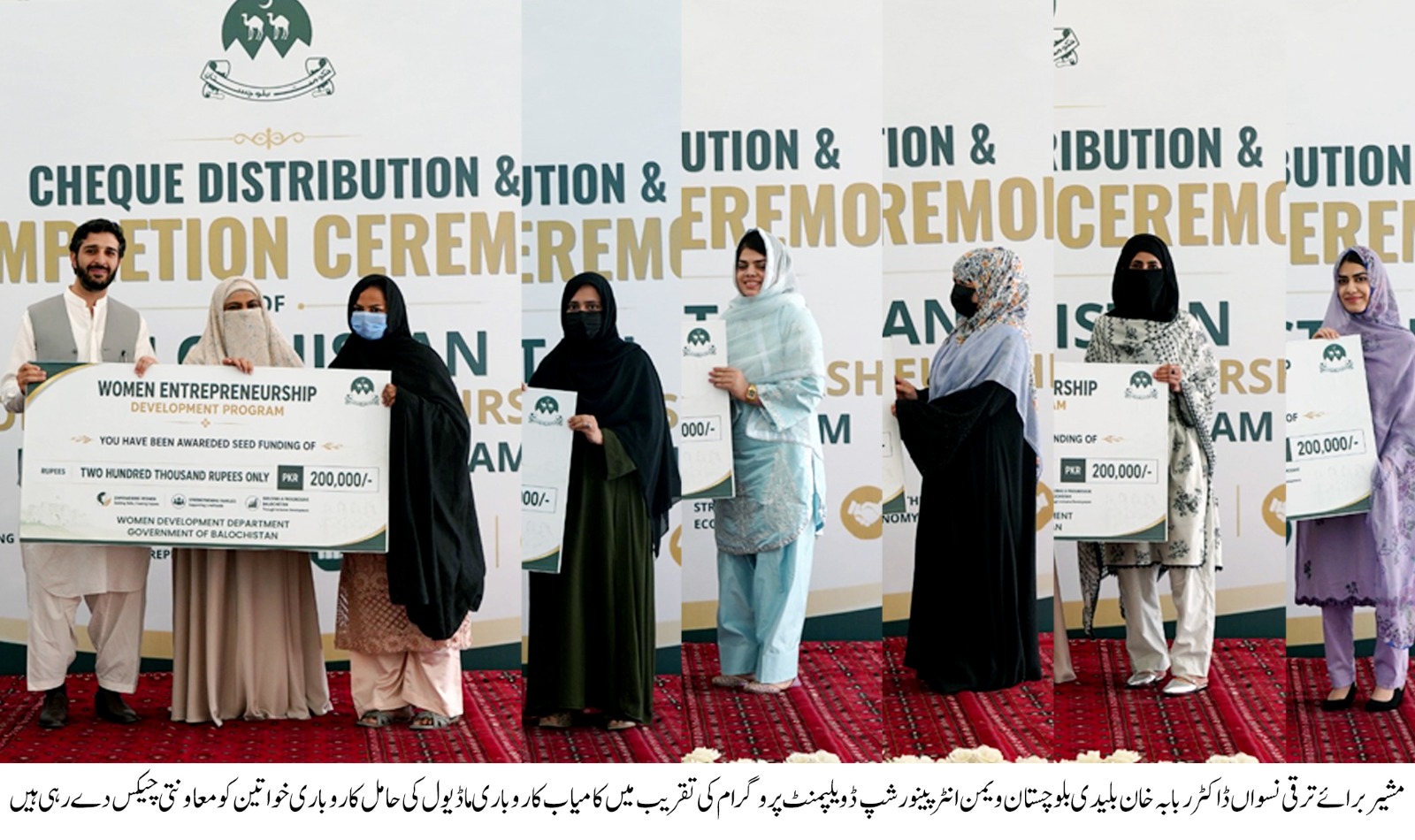
The programme, implemented by the Balochistan Women Development Department, has already moved beyond the training stage for a significant number of participants. One hundred trained women have started their own businesses, while financial assistance has been provided to help them establish and expand their entrepreneurial activities. Each of the 100 women received a support cheque of Rs200,000, bringing the total financial assistance under this phase to Rs20 million.
This approach carries an important message: empowering women economically requires more than teaching them a skill. Training becomes truly meaningful when women are also provided with the resources, confidence and opportunities needed to transform their abilities into sustainable sources of income.
For a province like Balochistan, where economic opportunities remain unevenly distributed across urban and rural areas, initiatives aimed at women’s entrepreneurship can have far-reaching social and economic consequences. Women who establish small businesses can contribute directly to household incomes, improve financial resilience and create opportunities for others within their communities.
The significance of the programme also lies in its emphasis on entrepreneurship rather than merely employment. Instead of limiting women to the role of job seekers, the initiative seeks to develop them as business owners and potential job creators. This is an important change in perspective because small and medium-sized enterprises can become a foundation for broader economic activity, particularly when local talent is connected with appropriate financial and institutional support.
The programme also reflects a broader policy vision in which women’s empowerment is linked with family welfare and economic development. When women gain greater control over their income and economic decisions, the benefits can extend beyond the individual entrepreneur. Household spending on education, health, nutrition and other essential needs can improve, creating positive effects for children and future generations.
Balochistan possesses considerable human potential, and its women represent a largely underutilised component of that potential. The challenge is not a lack of talent or ambition but ensuring access to training, finance, markets, technology and mentorship. A successful entrepreneurship ecosystem must therefore continue beyond the initial financial grant. Women entrepreneurs need guidance in business planning, digital marketing, financial management, access to markets and the development of competitive products and services.
The completion of training for 600 women is consequently an encouraging beginning rather than an endpoint. The next challenge is to ensure that these women-led businesses remain sustainable and that successful models are replicated across the province. Expanding such programmes to more districts, particularly underserved communities, could create a wider network of women entrepreneurs and strengthen grassroots economic activity.
Economic empowerment should ultimately be measured not only by the number of women trained or the amount of financial assistance distributed, but by the number of sustainable businesses created, incomes generated, jobs provided and families whose economic prospects improve.
The Women Entrepreneurship Development Programme offers a promising example of how public policy can connect skills, finance and opportunity. If sustained and expanded, such initiatives can help transform women from passive participants in the economy into active contributors and entrepreneurs.
For Balochistan, investing in women’s economic empowerment is not simply a social responsibility. It is an investment in stronger families, more resilient communities and a more inclusive provincial economy.