
Editorial
Ayaz Sadiq’s Quetta Visit: A Renewed Federal Interest in Balochistan’s Development
The visit of National Assembly Speaker Sardar Ayaz Sadiq to Quetta carries significance beyond the routine movement of a federal political figure. At a time when Balochistan continues to face complex developmental, economic and infrastructural challenges, a visible engagement between the federal Parliament and the provincial leadership sends an important message: the province’s development requires sustained national attention and a stronger partnership between the federation and Balochistan.
Balochistan occupies a unique position within Pakistan’s political geography and economic future. It is the country’s largest province by area, possesses substantial mineral and natural resources, has a strategically important coastline and remains central to Pakistan’s regional connectivity. Yet its development indicators continue to reflect gaps in infrastructure, healthcare, education, employment opportunities and basic public services.
Against this backdrop, visits by senior federal representatives to the province should be viewed as opportunities to strengthen institutional coordination rather than merely ceremonial engagements.
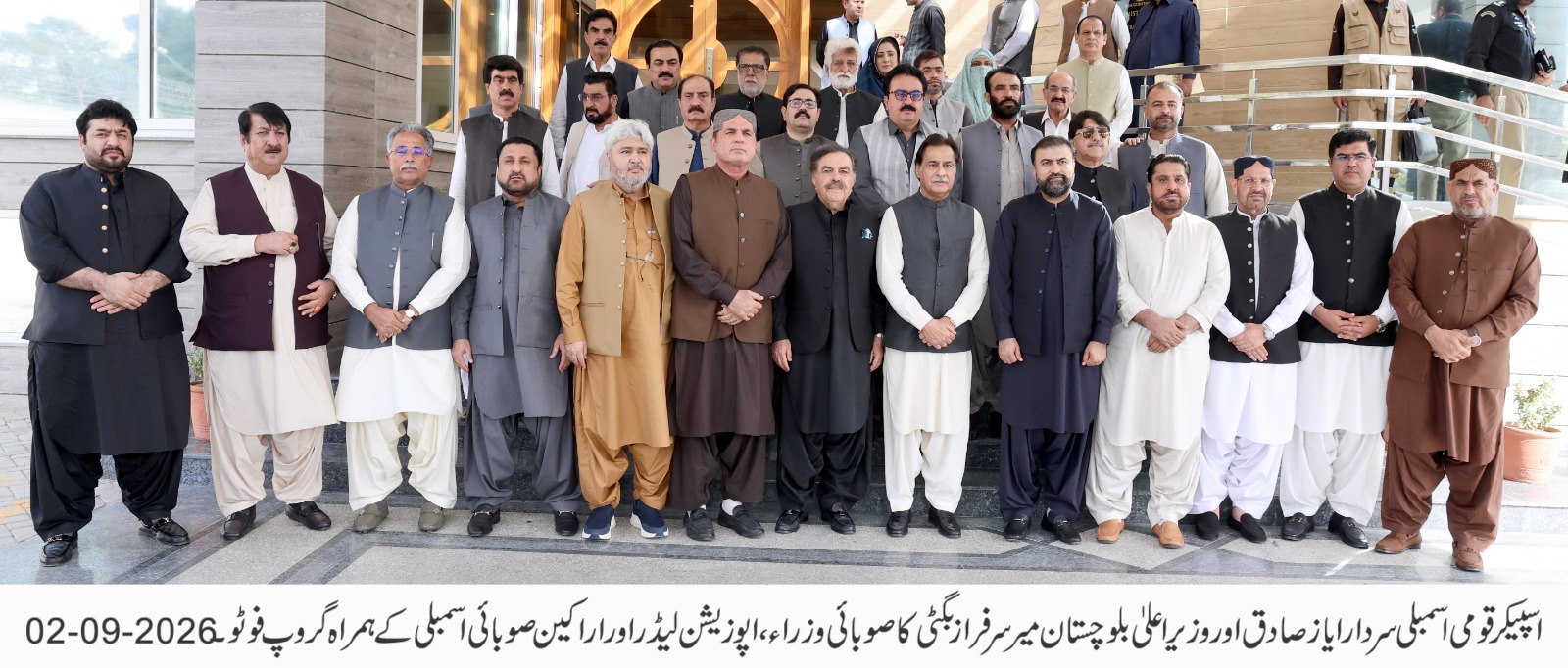
The Speaker’s visit to Quetta, including his interaction with the provincial leadership, cabinet members and representatives from different political backgrounds, provides an opportunity to reinforce the constitutional and political relationship between Islamabad and Quetta. Such interaction is particularly important for a province where many development projects and economic opportunities depend on effective coordination between federal and provincial institutions.
Balochistan’s challenges cannot be addressed through provincial resources alone. The scale and geographical spread of the province, combined with the cost of delivering infrastructure and public services to remote communities, require long-term federal support. At the same time, provincial institutions must ensure that available resources are translated into tangible improvements in people’s lives.
The most productive form of federal engagement, therefore, is one that focuses on outcomes.
For the people of Balochistan, development is ultimately measured through better roads, reliable electricity, clean drinking water, functional hospitals, quality schools, employment opportunities and greater access to markets. Large national projects matter, but their benefits must reach local communities if they are to create a lasting sense of inclusion and economic participation.
The province also represents one of Pakistan’s greatest economic opportunities. The mineral sector, particularly the potential associated with copper, gold and other strategic minerals, can become a major driver of economic growth if developed transparently, sustainably and with meaningful participation from local communities. Gwadar and the wider coastal belt also offer opportunities in trade, logistics, fisheries and maritime industries.
However, economic potential alone does not guarantee development. It requires infrastructure, human capital, security, institutional capacity and investor confidence. This is where federal-provincial coordination becomes essential.
Parliament also has an important role in ensuring that Balochistan’s concerns remain part of the national policy conversation. The National Assembly is not merely a legislative forum; it is an institution through which the federation can understand regional priorities and translate them into national policies and budgetary decisions.
A stronger parliamentary connection with Balochistan can help ensure that the province’s development needs receive sustained attention rather than temporary focus.
At the same time, political engagement must extend beyond government-to-government interaction. Balochistan has a diverse political landscape, and sustainable development requires the participation of elected representatives, opposition parties, civil society, business communities, youth and local stakeholders. Development becomes more durable when it is supported by broad political ownership.
The federal government, for its part, should continue strengthening mechanisms through which provincial priorities are incorporated into national development planning. Similarly, the provincial government must maintain transparency, improve governance and ensure that development funds are utilised efficiently and equitably.
Security and development must also be understood as interconnected challenges. No meaningful economic transformation can take place without peace and stability, while sustainable peace is strengthened when citizens have access to education, healthcare, employment and economic opportunity. A comprehensive approach is therefore required—one that combines security measures with social and economic development.
The Quetta visit should consequently be seen as an opportunity to deepen a broader national conversation about Balochistan’s future. The province should not be viewed only through the lens of security or resource extraction. It must be recognised as an integral part of Pakistan’s economic, democratic and social future.
The message from such federal engagement should be clear: Balochistan’s development is not a provincial concern alone; it is a national responsibility.
Pakistan’s long-term prosperity will depend, in considerable measure, on how successfully it converts Balochistan’s vast geographic, human and economic potential into inclusive development. That requires continuity of policies, stronger institutions, responsible politics and genuine cooperation between the federation and the province.
Sardar Ayaz Sadiq’s visit to Quetta thus provides an appropriate moment to reaffirm an important principle: the federation is strongest when its institutions remain connected with every part of the country. For Balochistan, sustained federal attention, combined with effective provincial governance, can help transform development commitments into measurable improvements in the lives of its people.
The real significance of the visit will ultimately be determined not by the meetings themselves, but by what follows them. If dialogue leads to coordination, coordination produces policy, and policy delivers results on the ground, then such engagements can contribute meaningfully to a more prosperous, connected and inclusive Balochistan.