
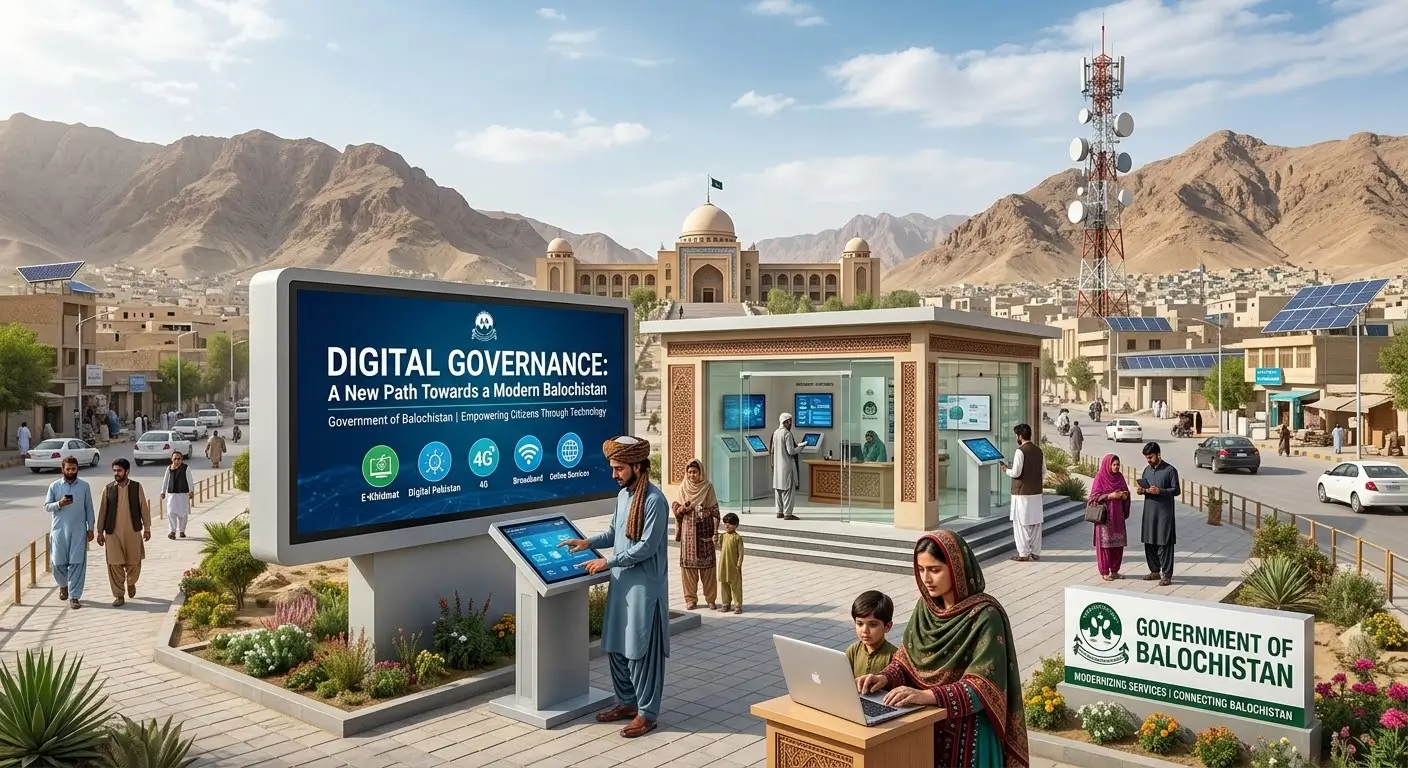
Digital Governance: A New Path Towards a Modern Balochistan
By Rakhshanda Saba
Digital transformation is no longer a choice for modern governments; it has become an essential instrument for delivering efficient, transparent and citizen-centred public services. For Balochistan, a province blessed with enormous natural resources, a young population and vast geographical potential, digital governance offers an opportunity to overcome some of the structural challenges that have historically affected public administration and service delivery.
The concept of digital governance goes far beyond replacing paper files with computers. It represents a fundamental transformation in the way government institutions function, communicate with citizens and make decisions. A modern digital governance system can reduce unnecessary bureaucratic delays, improve transparency, strengthen institutional coordination and enable citizens to access public services without repeatedly visiting government offices.
For a province as geographically extensive as Balochistan, this transformation is particularly important. Distance has traditionally been one of the major barriers to access to government services. Citizens living in remote districts may have to travel long distances simply to obtain a certificate, submit an application, verify documents or follow up on an official matter. Digital platforms can significantly reduce this burden by bringing essential government services closer to citizens—regardless of where they live.
Balochistan has already begun moving towards this transformation through initiatives aimed at digitising public services and administrative processes. The introduction of systems such as e-Domicile and e-Local Certificate is an important indication of how technology can make routine government services more accessible, efficient and transparent. Such initiatives can also help reduce opportunities for unnecessary human intervention and improve the integrity of official records.
The real potential of digital governance, however, lies in creating an interconnected ecosystem rather than isolated digital projects. Government departments should gradually move towards interoperable systems through which information can be securely shared, verified and processed. A citizen should not have to provide the same information repeatedly to different departments when the government already possesses that information in an authorised digital record.
Digital governance can also play a transformative role in improving accountability. Properly designed digital systems can create electronic trails of applications, approvals, payments and decisions. This makes it easier to monitor administrative performance and identify delays or irregularities. For policymakers, reliable digital data can provide a clearer picture of what is happening on the ground and help them allocate resources according to actual needs rather than assumptions.
Another major area of opportunity is education. Balochistan’s young population represents one of its greatest assets, and digital connectivity can provide young people with access to educational resources, online training and employment opportunities beyond traditional geographical limitations. Digital libraries, online learning platforms and technology-based skills programmes can help bridge the gap between students in major urban centres and those living in distant districts.
Healthcare is another sector where digital governance can make a meaningful difference. Telemedicine, electronic health records and digitally connected health facilities can improve access to medical advice, particularly for communities located far from major hospitals. Technology cannot replace doctors or healthcare infrastructure, but it can help extend the reach of existing resources.
The same principle applies to agriculture, livestock, local government, taxation and social welfare. Digital databases can help identify beneficiaries, monitor programmes and improve the distribution of public resources. In agriculture, digital information can assist farmers with market information, weather updates and access to government support. In local government, online complaint and monitoring systems can make municipal services more responsive.
Yet digital transformation must be approached with realism. Technology alone cannot solve administrative problems. Digital governance requires trained human resources, reliable connectivity, cybersecurity, data protection and strong institutional ownership. Balochistan’s remote and mountainous areas present particular challenges in terms of connectivity and infrastructure. Therefore, digital expansion must be accompanied by investment in broadband access, electricity, technical capacity and digital literacy.
Cybersecurity must remain an integral part of the digital governance agenda. As government services become increasingly dependent on digital platforms, the protection of citizens’ personal information and government databases becomes a matter of public trust and national security. Strong security standards, responsible data management and trained cybersecurity personnel will be essential.
Equally important is the need to ensure that digital governance remains inclusive. Technology should not create a new divide between citizens who have easy access to smartphones and the internet and those who do not. Government service centres, assisted digital facilities and public awareness programmes can help ensure that vulnerable and remote communities are not excluded from the benefits of digital transformation.
The ultimate objective of digital governance should therefore be simple: a government that is easier to access, faster in responding, more transparent in decision-making and more accountable for results.
For Balochistan, this is not merely a technological journey. It is an opportunity to redesign public administration around the needs of citizens. If implemented with political commitment, institutional coordination and sustained investment, digital governance can become one of the most powerful tools for improving governance across the province.
The future of Balochistan will be shaped not only by its minerals, geography and natural resources, but also by the quality of its institutions. A digitally empowered government can help transform distance into accessibility, bureaucracy into efficiency and data into better decisions.
Digital Balochistan, therefore, should not be seen simply as a vision for the future. It should be treated as a practical pathway towards a more transparent, efficient and citizen-focused province.