
Balochistan Assembly discusses Panjgur development projects, border trade revival and arabic language education
Quetta: The Balochistan Assembly on Friday disposed of a calling-attention notice concerning delayed development projects in Panjgur district after the provincial government informed the House that the matter of funding had been taken up with the Finance Department.
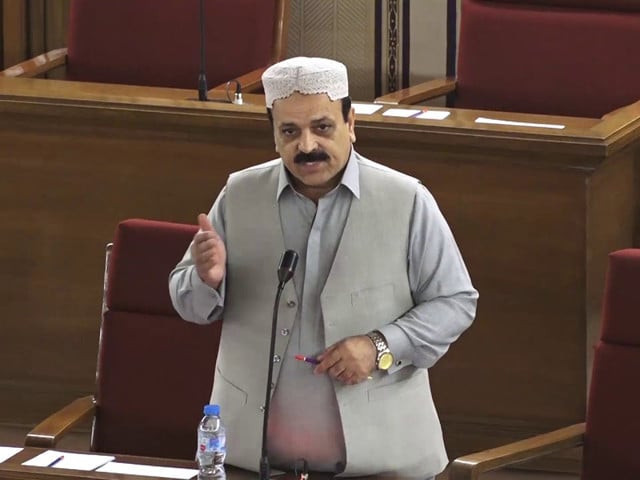
The notice was moved by Member of the Provincial Assembly Mir Asadullah Baloch during a session chaired by Deputy Speaker Ghazala Gola. He highlighted that several road infrastructure projects in Panjgur, including the Shaheed Chowk-Garkman Road scheme, were approximately 80 percent complete, while the remaining work had stalled due to insufficient funding.
According to the lawmaker, only one to two percent of the required funds had been allocated for the projects, making it difficult to complete the remaining work before the schemes’ deadlines expire. He sought details from the government regarding measures taken by the Communication and Works Department to ensure completion of the projects.
Responding to the notice, Provincial Minister Mir Saleem Khosa said that a formal request had already been submitted to the Finance Department for the release of funds for four development schemes in Panjgur. He added that the issue was not limited to projects raised by Mir Asadullah Baloch but was part of a broader funding challenge affecting nearly 300 development schemes across Balochistan.
During the same session, Balochistan Assembly member Shahida Rauf welcomed recent remarks by Lieutenant General Inayat Hussain, Commander of the 12 Corps, regarding the reopening of border crossings and called for concrete action to implement the proposal.
Speaking on a point of order, Shahida Rauf said the positive stance expressed by the Corps Commander had raised hopes among people living in the province’s border regions. She emphasized that border trade serves as a critical source of income for thousands of families in Balochistan.
She urged authorities to translate statements into practical measures, arguing that reopening border trade routes would create employment opportunities, reduce economic hardship and boost commercial activity across the province.
According to the legislator, restoring border trade would play a significant role in improving local economic conditions and supporting communities dependent on cross-border commerce for their livelihoods.
The Balochistan Assembly also approved a resolution recommending the introduction of basic Arabic language education in all government primary schools across the province.
The resolution, tabled by MPA Shahida Rauf, called for providing children with equal opportunities to learn Arabic from the earliest stages of their education. It stated that Arabic, being the language of the Holy Quran, could help students better understand Quranic vocabulary and the meanings of verses through foundational language instruction.
The resolution recommended incorporating basic Arabic vocabulary, grammar and commonly used Quranic words into the primary school curriculum. It also called for the provision of standardized textbooks, trained teachers and appropriate educational resources to support the programme.
During the debate, former Chief Minister Dr Abdul Malik Baloch expressed support for Arabic language education but stressed that Balochistan’s indigenous and mother languages should also be included in the curriculum.
He recalled that legislation promoting mother-tongue education had been passed in 2013 and urged authorities to ensure its implementation so that future generations remain connected to their linguistic and cultural heritage.
MPA Kulsoom Baloch also supported the inclusion of native languages in schools, arguing that nations which fail to preserve their language, culture and civilisation risk losing their identity over time.
Provincial Education Minister Raheela Hameed Durrani informed the House that, under existing legislation, schools are already teaching the Holy Quran with translation and recitation. She said Arabic has been incorporated into the curriculum and Quranic studies are taught from lower grades through higher levels of education.
Raheela Durrani added that the government is committed to introducing education in mother languages as well, although implementation has been slowed by resource constraints and other challenges.
Following the discussion, the Assembly unanimously approved the resolution advocating the introduction of basic Arabic language education in government educational institutions across the province.