
Editorial
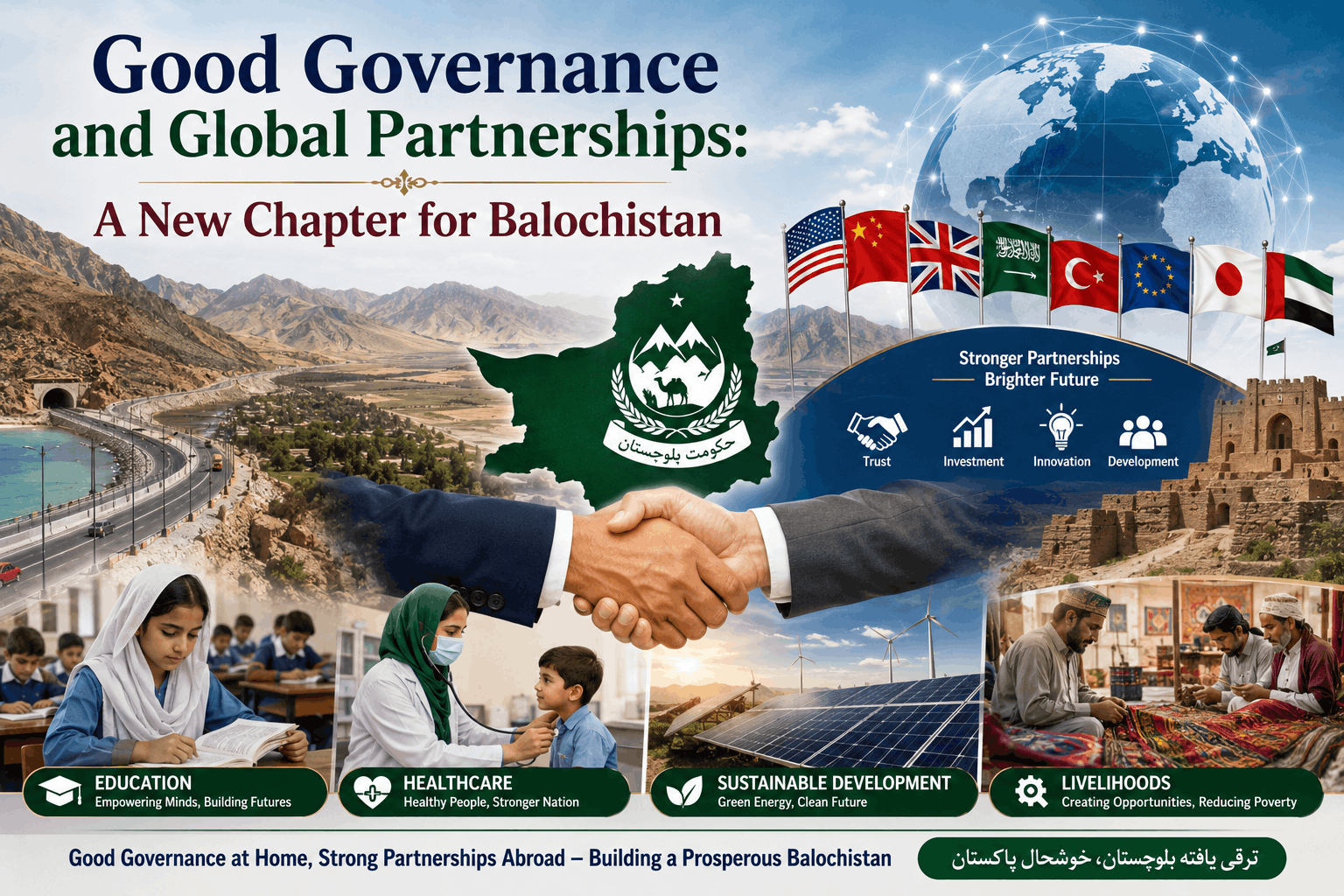
Good Governance and Global Partnerships: A New Chapter for Balochistan
The meeting between the Chief Minister of Balochistan, Mir Sarfraz Bugti, and the British High Commissioner to Pakistan, Ms. Jane Marriott, carries significance beyond diplomatic protocol. It reflects a shared recognition that sustainable development is best achieved through strong governance, meaningful reforms, and constructive international partnerships. At a time when Balochistan is pursuing an ambitious agenda of institutional strengthening and economic transformation, such engagements provide valuable opportunities to exchange ideas, build confidence, and explore practical avenues of cooperation.
Balochistan stands at an important point in its development journey. Endowed with abundant mineral resources, an extensive coastline, rich cultural heritage, and a strategic geographical location connecting South Asia, Central Asia, and the Middle East, the province possesses enormous potential. However, realizing this potential requires more than natural wealth. It demands transparent governance, capable institutions, investment-friendly policies, and a sustained commitment to improving the quality of life for its people.
In recent years, the provincial government has emphasized reforms aimed at making public institutions more responsive, transparent, and efficient. Digital governance initiatives, improvements in public service delivery, and administrative reforms are intended to create a government that serves citizens more effectively. Such measures not only improve governance but also enhance public trust, which remains one of the most valuable assets for any democratic administration.
The discussions during the meeting reportedly focused on education, healthcare, governance, investment, and development cooperation. These sectors are interconnected and collectively determine the pace of socio-economic progress. Education, for example, remains one of the strongest drivers of long-term development. Investing in schools, universities, vocational training, and digital learning prepares young people to participate productively in a rapidly changing global economy. Balochistan’s youthful population represents an enormous opportunity, provided it receives quality education and relevant skills.
Healthcare is another sector where international collaboration can make a meaningful difference. Expanding access to quality medical facilities, strengthening emergency healthcare systems, improving maternal and child health services, and enhancing professional medical training are areas where knowledge-sharing and technical cooperation can complement local efforts. Better healthcare ultimately translates into healthier communities, higher productivity, and improved human development indicators.
Economic growth depends heavily on investment, and Balochistan offers significant opportunities across multiple sectors. Mining, energy, fisheries, agriculture, tourism, and logistics all hold immense promise. However, investors seek stability, policy consistency, transparent regulations, and efficient public institutions. Strengthening governance therefore becomes an economic necessity as much as an administrative objective. International partners can contribute not only financial resources but also technical expertise, innovation, and global best practices that support sustainable economic development.
Equally important is institutional capacity building. Strong institutions provide continuity beyond political cycles and ensure that development initiatives produce lasting results. Training public officials, improving administrative systems, promoting evidence-based policymaking, and encouraging transparency contribute to better governance and more effective service delivery. These are areas where international cooperation can complement provincial priorities without replacing local ownership of development.
Chief Minister Mir Sarfraz Bugti has repeatedly emphasized that peace, development, and public welfare are inseparable. Lasting economic progress requires a secure environment, while improved economic opportunities themselves contribute to greater social stability. This integrated approach recognizes that infrastructure projects, educational reforms, healthcare improvements, youth engagement, and employment generation collectively strengthen both development and social cohesion.
International partnerships should always be viewed as relationships based on mutual respect and shared objectives. Successful cooperation is not measured merely by financial assistance but by the transfer of knowledge, institutional strengthening, technological innovation, and long-term sustainability. The partnership between Pakistan and the United Kingdom has historically covered education, governance, humanitarian assistance, climate resilience, and economic development. Expanding this engagement within Balochistan presents opportunities that can benefit both sides while advancing the province’s development priorities.
The private sector also has an essential role to play. Public-private partnerships, responsible investment, entrepreneurship, and innovation can accelerate economic growth and create employment opportunities for thousands of young people. Government policies that encourage investment while maintaining transparency and accountability can help unlock the province’s vast economic potential.
Ultimately, the future of Balochistan will be shaped by its ability to combine visionary leadership with effective governance and productive partnerships. Diplomatic engagements such as the meeting between Chief Minister Mir Sarfraz Bugti and British High Commissioner Jane Marriott demonstrate a willingness to engage with the international community in pursuit of shared development goals. Such dialogue builds confidence, encourages cooperation, and reinforces the message that Balochistan is committed to reform, stability, and sustainable progress.
The road to prosperity is neither short nor simple, but it becomes more achievable when governments remain focused on good governance, institutions continue to improve, and international partners contribute through constructive collaboration. By investing in its people, strengthening its institutions, and embracing meaningful partnerships, Balochistan can confidently move toward a future defined by opportunity, resilience, and inclusive development.